
Author: Matthew Huff
My Daughter Speaks with Thunder
This is a poem dedicated to my daughter Julianna, the girl who says hello to the thunder:
My daughter speaks with thunder,
Letting go of a thousand wishes drawn from her little well,
Lips stirred by the sweeping spells of starlight,
A congregation of electric clouds clapping the chorus,
Humming hymns.
When lightning rips the violet sky,
Like mice scratching faster than traps,
Cheese in cheek,
My child betrays her young lungs with the fragile yell
Of determined humans,
Daring to harmonize with the heavens.
She smiles and dances to me,
The harps in her throat still laughing with song,
When her hands outstretch to unveil
A dozen little berries,
Dizzy from the sugar they’ve drunk,
And I see the glory of this gummy communion,
As my daughter chomps on her backyard treasure,
Barrels her hellos to the evening,
And God the Father belly laughs
A shower of rain in response.
To My Mother on Her Birthday
My mother’s birthday is today, and I wanted to honor her and everything she has done for my family and me by writing this poem for her. Happy birthday, Mom.
I saw her breathing deeply
As I stared through strands of tumbling hair,
Like little wispy veils,
Slurring my sleepy vision as I shivered at her bedside.
I was small and scared and four.
My mother’s sleep lay on her thick as quilts,
Lulling her tired bones to the rest of sacred dreams,
Filled with the iron ballast of a day of boundless worship:
Her living room worn by the hymns of an aged vacuum,
Choruses offered as sacred vespers,
The clouds of sunset filling her temple,
My mother’s domestic liturgy.
I see her hands fold behind her pillow,
Fingers faded by the baptism of dishes,
The scrape of cereal from the bowl and the wisdom of rags
Wiping away the filth of human failures.
Her forehead lightens as her mind replays
The wonders of laughter
And the splattering grace of the evening meal,
Smeared cheeks chewing on the Passover,
Remembrances of a body broken
As my mother’s bends beneath the steam of a swollen oven,
Her electric altar of praise.
My little voice whispers through missing teeth
That the dragon in my room was snarling again,
Its bared fangs aching for the taste of boy,
And I needed her to rescue my wet sheets.
Her eyes half-closed,
Limbs dangling from the strings of endless love,
She stumbles to the linen closet as I anxiously peer through the dark,
Searching for the twin braids of smoke in the shadows of my urine-stained room,
Trusting in the holy strength of my beautiful mother
Whose arms bear the load of a midnight sacrifice
And whose kiss can slay the dragons.
Review: Notes from the Tilt-a-Whirl
 Notes From The Tilt-A-Whirl: Wide-Eyed Wonder in God’s Spoken World by N.D. Wilson
My rating: 5 of 5 stars
Well, the apple certainly doesn’t fall far from the tree. Nate’s outlandish work (in the most positive sense) is quite reminiscent of some of his father’s style and metaphorical craftsmanship. Nate is a supremely gifted writer, every page of this wonderland text dripping with poetic imagery. Perhaps the most obvious triumph of these Notes is the way Nate holds the damper pedal for 200 pages, seamlessly sustaining his poetic edge to the end. Incredible endurance.
This work, more like a kaleidoscope than a book, was a breath of glorious air. Actually, more like a gust. Or maybe a cyclone. Possibly, a speeding planet.
Athwart History: A Tribute to W.F.B. [Video]
 In light of a recent biography of William F. Buckley, Jr. I just finished, I’d like to share this tribute video to the sailing Yalie, the conservative Catholic, the ever charming, insatiably witty, fiercely prolific, and undeniably audacious voice of American conservatism. I owe great thanks to my father for introducing me to Buckley through clips of Firing Line.
Enjoy.
Grand Forces Afoot
“Picture a soldier pinned down behind a sand dune on Normandy beach. He’s just landed; he’s behind the sand dune and can’t get to the next sand dune. He can’t achieve his next objective because he’s pinned down by enemy fire. He’s just stuck, and he’s in a bad jam.
Suppose that, at this point, we make the illustration ludicrous, that a stray sheet of paper from Eisenhower’s invasion plans for Europe got detached from the notebook and is blowing down the beach. It lands on the soldier, and he looks at it and it says, “From Gen. Eisenhower…” and the orders to Eisenhower are to establish a beachhead on the continent of Europe and to take Berlin.
He looks at these orders, and he can’t even get past his own sand dune. He could be tempted to despair, on the one hand, because “How could we do this when I can’t even do that?“, but he could also be, if he is thinking about it rightly, he could be greatly encouraged and say, “However stuck I am, there are grand forces afoot. However stuck I am, there are whole armies in collision. I’m just one small part of the puzzle; I’m just one small part of this, and the only thing I can do is be faithful at my post, be faithful where I am, and if I am, then I’ll just leave the results to a sovereign God.
And that’s how I feel. There are times when I feel stuck behind my sand dune. There are times when I feel like, “Why can’t we do more? Why can’t we communicate more effectively? Why can’t we get this done?” And then, a page out of Matthew 28 blows down the beach and, ‘All authority in heaven and on earth has been given to me,’ Jesus says. ‘Therefore go and make disciples of all nations, baptizing them […] teaching them to obey everything I have commanded you.’
The Christian faith is a religion of world conquest.”
-Doug Wilson, Free Speech Apocalypse (for the quotation, begin at 1:28:03)

Jean Valjean and the Face of God
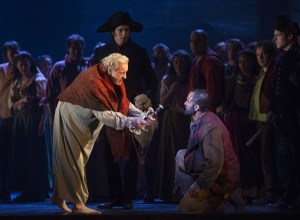 At the end of Les Misérables, as Jean Valjean lies dying before his beloved daughter Cosette and her husband-to-be Marius, the musical swells to a beautiful arrangement of different musical themes sung by Valjean, a vision of Fantine, and reprising his earlier role, the Bishop of Digne. In this stirring scene, Valjean commends Marius and Cosette to marry and reveals his long-held secret that he, in fact, is prisoner #24601, tired from a life of running from the law. As Valjean sings his last confession, Fantine appears to welcome him into heaven, accompanying his reflection on the grace he has been shown and his attempt to live a life worthy of it. At last, Valjean sees the Bishop, the noble priest who initiated the entirety of Valjean’s redemption by welcoming him to his home, forgiving his crime, and graciously setting him free, transforming him into a new man whose soul has been “bought for God”. Notice the kindness and sacrificial love of the priest as he gives Valjean the candlesticks at the beginning of the musical:
“But my friend you left so early / Surely something slipped your mind / You forgot I gave these also / Would you leave the best behind?”
Here, in Valjean’s final hour, he experiences an almost beatific vision of the priest, surrounded gloriously in candlelight in the 2012 film adaptation, as they sing one of the show’s most gorgeous lines:
“To love another person is to see the face of God”
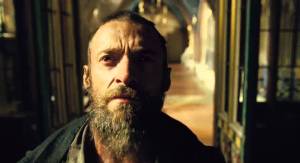 No statement better captures the spiritual center of the story as Valjean fully takes the measure of how strong grace truly is. One simple act of kindness, unmerited yet fully proffered, has the power to transform a filthy sinner into a forgiven saint. Even in his humble and lowly position, the priest became a vessel for Valjean and, by extension, the audience to see the very face of God through his indefinable love for an embittered thief.
For such wild forgiveness and abundant grace effuses from our Father, the Almighty God who turns slaves into sons and frees us all from the burdens of our many years in prison. Like the Bishop, God offers rest for the weary, comfort for the resentful, love for the unloving and unlovely. Like the Bishop, God transforms the nameless prisoner (24601) into a new man, restored to life, saved not by good works but to them, called to let the grace with which he’s been filled spill over to another. When Valjean is forgiven, he is free to shed his old life and commit himself to a life of service, redeeming little Cosette from her equally dismal life.
In I John 3:16, the apostle describes this love of the Father: “By this we know love, that he laid down his life for us, and we ought to lay down our lives for the brothers” This selflessness characterizes love and, as God is love, draws us closer to His nature. Since we are called to imitate God (Eph. 5:1), learning to love others as He is love is the way forward.
In Romans, “Owe no one anything, except to love each other, for the one who loves another has fulfilled the law.” Incidentally, this truth explains Javert’s ultimate self-destruction. No man so bound to the duties of the law can function, for the law is fulfilled in love; the only way Christ could fulfill the law is in his final breath dying for His friends. As Javert’s inability to cope with such love and grace becomes his undoing, Valjean’s embrace of it in giving his life to Cosette, Marius, and the dozens of young boys at the barricades becomes his way to salvation.
“Above all, keep loving one another earnestly, since love covers a multitude of sins. Show hospitality to one another without grumbling . As each has received a gift, use it to serve one another, as good stewards of God’s varied grace” (I Peter 4:8-10).
From Kansas to Oz: The Poetic Excursions of Billy Collins
 Yes, you must forgive me for making another plug for the poetry of Billy Collins. But seeing as today marks the one-year anniversary of launching Eden.Babel, I find myself musing, like Bilbo Baggins, on the nature of the journeys we take, a reflection Collins often considers in his work.
For me, Collins’ is the one poetic voice that has resonated most beautifully concerning the process of sojourning; in the pithy breath of a lyrical phrase, he captures the massive undertakings we begin in the simple acts of ordinary mornings: the epic quest of frying an egg, the poetic brilliance of cleaning a windshield. As I mentioned in a previous post on Collins, someone once gorgeously quipped that his poetry “begins in Kansas and ends in Oz.” This is the majesty of Collins’ work, that the reader can begin the poem introduced to the most mundane of settings, yet find himself struck by the lightning of a startling stanza within seconds. For example, I recently purchased his collection Horoscopes for the Dead, flipped to the first poem, and read these lines:
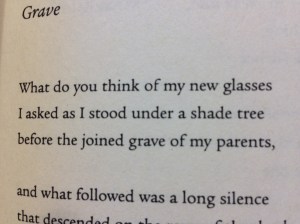
Only Collins can produce this effect. The speaker begins with an utterly casual and unceremonious question (“What do you think of my new glasses?”), moves to an equally casual setting (“I asked as I stood under a shade tree”), then smoothly slides back the curtain to reveal the quiet distress of the grief the speaker bears (“before the joined grave of my parents”). This is the signature movement of Collins, to show his speaker caught between the subtle, almost childlike question for approval – What do you think? – and the bare melancholy of reality. This is the journey from ordinary to extraordinary, mundanity to magic, that makes Collins’ voice a powerhouse for effect and provocative insight. This is the punch of his poetry.
And so, I leave you with the charge to discover Collins for yourself. Brace yourself for the knockout.
The Ameri-Con Man: How Harold Hill and Jay Gatsby define America
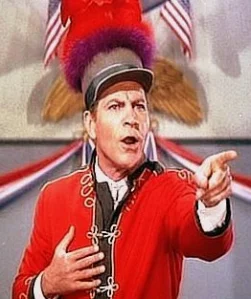
“Remember, my friends, listen to me because I pass this way but once.”
From Meredith Wilson’s Tony-winning musical The Music Man and F. Scott Fitzgerald’s perennially high-school required read The Great Gatsby spring two of the cleverest and most dapper American heroes to feature in our star-spangled tradition. Yet, the word “hero” is clearly a troubled one in these works, for both Hill and Gatsby (if we may even refer to them as such since both monikers are pseudonyms) complicate the water of conventional heroics. Undoubtedly, they enthrall their audiences, luring us all in with their smoke-and-mirrors masquerade. They are truly dazzling figures, quick-witted charlatans with magnetic appeal and magical, theatrical aplomb. Their uncanny ability to wink-and-nod through life, to deflect the truth with a carefully-timed joke, to blur unpleasant realities with enough lights and music (indeed with seventy-six trombones) to encourage the fantasy of the American dream – even if the supports have been lamed decades ago – stuns us, leaving us with just enough patriotic paralysis to miss the haunting possibility that behind the American camouflage lies a hollow and corroded void.

“They’re such beautiful shirts […] It makes me sad because I’ve never seen such beautiful shirts before.”
In this post, then, I’d like to introduce a comparison of both Hill and Gatsby as quintessential American figures, earnest and romantic heroes pursuing illusory and counterfeit means of achieving their dreams. They are pied pipers, whistling and parading the nation in an endless and indefinite march toward ever-receding hopes. Yet, they are not cruel, for they are equally caught up in the cavalcade, spirited themselves by the glittering exuberance of the red, white, and blue. In short, they represent the modern American in desperate need of spiritual redemption and salvation from the treadmill of the American dream.
- Empty Yesterdays
Much of what motivates both Harold Hill and Jay Gatsby in their construction of false identities and flashy theatrics is a settled fear of the wasted life, a molded leaf-pile of regrets and missed opportunities.
As Hill requests to meet Marian Paroo, the reticent, independent town librarian, at the footbridge for a romantic rendezvous, Marian hesitates, asking to postpone the meeting. Hill’s response reveals his fear of losing time: “Oh, my dear little librarian. You pile up enough tomorrows, and you’ll find you are left with nothing but a lot of empty yesterdays. I don’t know about you, but I’d like to make today worth remembering.” Though this romantic gesture may arguably be just an extension of Hill’s crafted persona, I believe this statement embodies Hill’s genuine sentiment, for it arrives at the point in the film where Hill is becoming most vulnerable and most transparent in his affections for Marian. Indeed, he sacrifices his entire industry in falling for her, a choice (or not?) equally true of Gatsby and Daisy.

“Can’t repeat the past? Why of course you can!”
For Gatsby, this fear of a lost past is summed up powerfully in one of his most famous lines spoken to the novel’s narrator Nick Carraway. In his attempt to regain Daisy Buchanan, the love of his life, from her husband Tom, Gatsby seeks to go back in time, to undo all of the damage done to their relationship over the last five years. Yet, Nick attempts to halt Gatsby’s efforts, claiming the rationale that one simply cannot repeat the past, to which Gatsby retorts, “Can’t repeat the past? Why of course you can!” Perhaps nowhere else in American letters is the tormented desire to redeem lost time put more conclusively, for Gatsby’s dream is not Daisy, but an echo of Daisy, a vision of Daisy as she once was, and as she fades further away in time with every passing hour, so must Gatsby’s outstretched hand remain suspended in the air. Hers is the green light always at the other end of the bay, and time, it seems, is the sea upon which we “beat on, boats against the current,” yet are always “borne back ceaselessly into the past.”
2. Promising Tomorrows
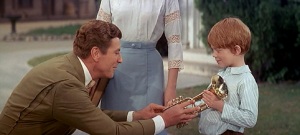
“I always think there’s a band, kid.”
The charm and the enduring glory of these characters must arise from their eternal optimism, the genuine hopefulness that lies at the core of their flair and self-confidence. For Harold Hill this attitude is most poignant in his interactions with young Winthrop, Marian’s withdrawn little brother. At one moment, Winthrop, distressed with the revelation that Hill is a fake, asks him if there’s no band either. Hill’s response encapsulates the American notion of tomorrow, that the dreams we believe in are pure even if the steps taken to reach them are faulty. Hill lovingly says, “I always think there’s a band, kid.” This is the distillation of Hill’s entire aim: there is always a noble calling to reach for, some beautiful dream to strive after.
For Gatsby this beautiful dream and his constant expectation of it is described as a gift. Nick says, “If personality is an unbroken series of successful gestures, then there was something gorgeous about him, some heightened sensitivity to the promises of life […] it was an extraordinary gift for hope, a romantic readiness such as I have never found in any other person and which it is not likely I shall ever find again.” Both Hill and Gatsby epitomize this “heightened sensitivity”; they are cognizant of the greatness and grandeur of life even if they are simultaneously beleaguered by the flawed approaches they take toward realizing it. In this way, they reveal the depths of the American experience, twisted by the corruptness of sin yet, as Loki declares, “burdened with glorious purpose.”
All is not lost, however. The so-called gorgeousness of these characters does bear a mark of truth and hopefulness, for the hollowness at the root of these heroes may be restored. While Gatsby is drowned by the overwhelming impossibility of his dream, we must remember that Hill is redeemed by the truth; exposed as the sinful man he is, Hill ends the musical disgraced, yet redeemed. As he tells Marian, he cannot go on as a con man since, for the first time in his life, he “got his foot caught in the door.”
May all our American performances, our daily struggle to maintain the sparkling masks of success, self-reliance, and selfishness, likewise get caught in the door so we may learn to accept our failures and live sacrificially, loving one another in truth.
May all our veils be abandoned that we may finally be human again.
Be Thou My Vision: Wordsworth and Seeing into the Life of Things
 It is often said that in the land of the blind, the one-eyed man is king. Yet, what must be said of the two-eyed man?
This is the sort of binocular vision afforded to the follower of Christ, the man or woman whose soul has been quickened by the Holy Spirit and, as C.S. Lewis taught us, has been led no longer to look at the sunbeam but to look along it, to track the ray of light, the small coruscation of glory, to the majesty of the sun. Christians have been tasked to navigate this blinded world not with a limping myopia of self-reliance and DIY spirituality but rather with the full vision of God, “For God who said ‘Let light shine out of darkness’ has shone in our hearts to give the light of the knowledge of the glory of God in the face of Jesus Christ” (II Cor. 4:6). Through His death, Christ has torn the veil, allowing all the saints a wide-eyed view of the wonder of Almighty God.
Throughout the Word of God, Christians are constantly invited “further up and further in”, a welcoming call to all who would follow Christ to see Him and all He will do:
“Taste and see that the Lord is good” (Psalm 34:8)
“Come and see what God has done: he is awesome in his deeds toward the children of man” (Psalm 66:5)
“The Word became flesh and dwelt among us, and we beheld his glory, the glory as of the only begotten of the Father, full of grace and truth” (John 1:14)
Even the great hymnist composed the beautiful lines: “Turn your eyes upon Jesus, look full in His wonderful face”
The Christian, then, has a distinct blessing of vision; as we look to the heavens, we see declared aloud the glory of God (Ps. 19:1). The early 19th century Romantic poet William Wordsworth, in his famous work “Lines Composed a Few Miles Above Tintern Abbey”, effectively demonstrates this sort of Christian vision as he meditates on the sublime beauty of the natural world:
“While with an eye made quiet by the power / Of harmony, and the deep power of joy, / We see into the life of things.”
-William Wordsworth (1770-1850)
This is the depth of Christian experience, what Jonathan Edwards would call a “God-entranced vision of all things.” Through the resurrecting power of God, Christians receive new eyes, new life, washed clean by the blood of the Lamb. With these new eyes of faith, we perform miracles: we see “into the life of things.” No longer are we waylaid by reductive materialism, the false sturdiness of earthly gain, or thin pleasures masquerading as true joy; rather, we see through them to discover the thickness and robustness of God. Remember, Christ’s resurrection body could pass through walls not because it was ghostly or wispy but, perhaps, because our material world is thin and feathery compared to the rich thickness of God.
And so, we must learn to see into the life of things, to track the sunbeam to the sun, to see the great abundance of the pleasure of God in and through the things He has made. As Doug Wilson suggests, we ought to “turn the soup into stew” and thank God for the freedom to see Him, for “we all, with unveiled face, beholding the glory of the Lord, are being transformed into the same image from one degree of glory to another” (II Cor. 3:18).
 Eden.Babel