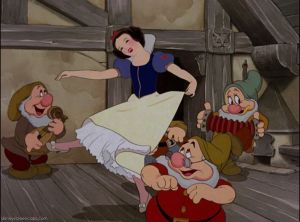
 A little over a year ago, I wrote a post referencing the Disney classic Sleeping Beauty and how its depiction of dragon-slaying and the victory of goodness over evil is quintessentially biblical, reverberating with the sweet harmonies of Jesus’ grand story. We now must turn to Snow White…
I brought home the movie a few weeks ago for my daughters to watch. Toward the end of the film, I was struck by the sheer power and depth of the story in displaying both the dilemma of death and the transcendent beauty of redemption, culminating in the glorious resurrection of all things. Indeed, the Bible teaches that Eden most certainly will be restored, and, to quote T.S. Eliot, “all shall be well, and / All manner of thing shall be well” (The Four Quartets). In his Revelation, John declares with valiant sureness, “And he who was seated on the throne said, ‘Behold, I am making all things new'” (Rev. 21:5).
It should be no surprise that the gospel can appear in the unlikeliest of places with the unlikeliest of transformative power. After all, all truth is God’s truth. Tolkien showed us this in his epic tale of a halfling saving all of Middle-Earth. Who can forget the disbelief, the skepticism many shared that the responsibility for the One Ring should fall to a lowly hobbit? Or that the salvation of all the Jews could rest in the hands of Esther, one who attained her royal position “for such a time as this” (Esther 4:14)?
Even more directly, Chesterton writes in his essay “The Ethics of Elfland” of the glorious beauty and wonder that fairy tales hold in presenting the most dynamic truth in truly astonishing ways:
“…We all like astonishing tales because they touch the nerve of the ancient instinct of astonishment. This is proved by the fact that when we are very young children we do not need fairy tales: we only need tales. Mere life is interesting enough. A child of seven is excited by being told that Tommy opened a door and saw a dragon. But a child of three is excited by being told that Tommy opened a door. Boys like romantic tales; but babies like realistic tales because they find them romantic…This proves that even nursery tales only echo an almost pre-natal leap of interest and amazement. These tales say that apples were golden only to refresh the forgotten moment when we found that they were green. They make rivers run with wine only to make us remember, for one wild moment, that they run with water…We have all forgotten what we really are”
Chesterton is right; fairy tales jolt us awake to the absolute vibrancy and wonder of God’s True Story. Indeed, these stories we tell are numinous, bathed in sunlight; we merely need eyes to see them. The world and its millions of stories, trickling through every pore of reality, are diaphanous, “charged with the grandeur of God” (Hopkins). Just as Plato described the awakening of man’s reason to see the light beyond the cave, for these are mere shadows before us, Lewis believed the resurrecting of man’s imagination drew us “further up and further in” toward the dawn of True Reality to see the glory of God’s story in living color. Kevin Vanhoozer writes, “To see the common things of daily life drawn into the bright shadow of the Christ – this is the mark of a well-nourished theological imagination. It is precisely the biblically formed and transformed imagination that helps disciples wake up and stay awake to what is, and will be, in Christ Jesus” (“In Bright Shadow”).
So, we must turn to the truth and beauty of Snow White not to be merely entertained but to equip the eyes of our imagination to see more clearly the truth and beauty of God’s Story.
The Bliss of Eden
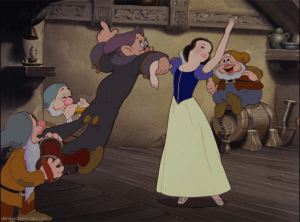 When Snow White arrives at the dwarves’ cottage, we see a warm and inviting portrayal of Eden: there are chores and tasks to be done (to the blissful tunes of whistling while you work, of course), there is community and fellowship, and the cottage is alive with song and dance. Merriment abounds. The story presents this way of life as a perfect balance of duty and desire; each person has a role to fill, and he or she fills it gladly. Sneezy is the one who sneezes, Happy is the one who is happy, Grumpy is the one who is grumpy, and so on.
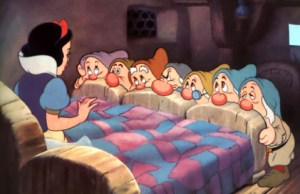
At the center of this pure and enchanting home is the image of Beauty herself, the ideal virtue incarnate in the character of Snow White, the proverbial “fairest of all.” She is undistorted by the seductions of the mirror, and she is elevated to the right position of a bride and mother, for the prince seeks her hand in marriage, and the dwarves seek her loving and affectionate arms in biblical domestic motherhood. She is the mother of all the living, and the eventual bride of the prince. The stage is set for the great Drama.
The Dilemma of Death
 Edenic paradise, God’s story tells us, is subject to the rebellion of man. It was only a matter of time before Snow White would face the choice to fall from the warmth and glory of her perfect home. And fall she does as she fills her mouth with the false deliciousness of the Queen’s poisoned apple and succumbs to the deep sleep of death. Yet, this sleeping death is no individual affair; the effects of her sin are not limited to her lifeless body. Indeed, all of nature is bent by her fall, and when the dwarves encase the body of Snow White in the glass coffin, all of creation attends to mourn the death of Beauty. It is a truly eerie scene in the film; Snow White lies beneath the numb sheet of sin and death, quiet and still, as her dwarves weep softly around her and all of the woodland creatures draw near to see and to mourn. In their sorrow, they know that ultimate Beauty has died and their perfect world has been damaged by darkness and evil. All of creation feels the sting.

The Kiss of Life
In this bleak moment of despair and sadness, the sleeping bride is powerless to rise from her bed of death. She needs the sweet kiss of a savior, the arrival of her great prince to bring her back to life. She needs resurrection, not only for her but for all the grieving world. Mourning must turn to morning.
And so arrives the great prince, ready to unseal the curse of death with the kiss of life. I challenge anyone to watch this scene and not whisper “amen” at the moment their lips touch, for this is truly our story. This is our greatest need. We are the sleeping Bride of Christ, desperately in need of Christ’s resurrecting power. Hear the old song:
“Long lay the world, in sin and error pining,
Til He appeared and the soul felt its worth,
A thrill of hope, the weary world rejoices,
For yonder breaks a new and glorious morn”
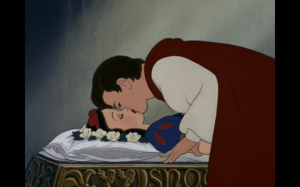
Indeed, our Prince has come to kiss us wide awake. Savor the beauty and the power of the Story.
Tolkien writes it this way:
“‘Gandalf! I thought you were dead! But then I thought I was dead myself. Is everything sad going to come untrue? What’s happened to the world?’
‘A great Shadow has departed,’ said Gandalf, and then he laughed and the sound was like music, or like water in a parched land; and as he listened the thought came to Sam that he had not heard laughter, the pure sound of merriment, for days upon days without count.”
Amen. May it be. A great Shadow has departed, and everything sad is coming untrue.
All shall be well, and all manner of thing shall be well.
We all live happily ever after.
 A few weeks ago, I had the privilege of touring the Museum of Biblical Art in Dallas and discovered a beautiful painting by Botticelli titled Madonna of the Book. In the center of this piece sits Mary with the Christ child on her lap as they both read from a medieval book of hours, a sacred devotional text common to Botticelli’s generation. Noticeably, Mary is pensive, contemplative, and even mournful in her pose as she studies the book.
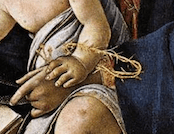 He was born to die. This is the will of God that “Jesus, delivered up according to the definite plan and foreknowledge of God, [be] crucified and killed by the hands of lawless men” (Acts 2:23). Indeed, Christ came into this world to “give his life as a ransom for many” (Matt. 20:28). As Mark Lowry famously wrote in a
 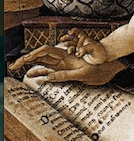 Yet, Christ guides her hand with His. “Keep reading. Keep reading.” Notice His left hand holding hers and His right hand guiding her back to the story. We must keep reading. Christ must die on the cross so that we must not. His steady and victorious look to His mother tells us everything. “I must do this for you,” he says to her and to us. “I love you. You must keep reading.” For as we keep reading, we discover that the story does not end at His death. In the words of the Battle Hymn, “Let the hero, born of woman, crush the serpent with His heel […] His truth is marching on.” He marches on. He marches on. Glory, glory, hallelujah.
 Eden.Babel