 It is often said that in the land of the blind, the one-eyed man is king. Yet, what must be said of the two-eyed man?
This is the sort of binocular vision afforded to the follower of Christ, the man or woman whose soul has been quickened by the Holy Spirit and, as C.S. Lewis taught us, has been led no longer to look at the sunbeam but to look along it, to track the ray of light, the small coruscation of glory, to the majesty of the sun. Christians have been tasked to navigate this blinded world not with a limping myopia of self-reliance and DIY spirituality but rather with the full vision of God, “For God who said ‘Let light shine out of darkness’ has shone in our hearts to give the light of the knowledge of the glory of God in the face of Jesus Christ” (II Cor. 4:6). Through His death, Christ has torn the veil, allowing all the saints a wide-eyed view of the wonder of Almighty God.
Throughout the Word of God, Christians are constantly invited “further up and further in”, a welcoming call to all who would follow Christ to see Him and all He will do:
“Taste and see that the Lord is good” (Psalm 34:8)
“Come and see what God has done: he is awesome in his deeds toward the children of man” (Psalm 66:5)
“The Word became flesh and dwelt among us, and we beheld his glory, the glory as of the only begotten of the Father, full of grace and truth” (John 1:14)
Even the great hymnist composed the beautiful lines: “Turn your eyes upon Jesus, look full in His wonderful face”
The Christian, then, has a distinct blessing of vision; as we look to the heavens, we see declared aloud the glory of God (Ps. 19:1). The early 19th century Romantic poet William Wordsworth, in his famous work “Lines Composed a Few Miles Above Tintern Abbey”, effectively demonstrates this sort of Christian vision as he meditates on the sublime beauty of the natural world:
“While with an eye made quiet by the power / Of harmony, and the deep power of joy, / We see into the life of things.”
-William Wordsworth (1770-1850)
This is the depth of Christian experience, what Jonathan Edwards would call a “God-entranced vision of all things.” Through the resurrecting power of God, Christians receive new eyes, new life, washed clean by the blood of the Lamb. With these new eyes of faith, we perform miracles: we see “into the life of things.” No longer are we waylaid by reductive materialism, the false sturdiness of earthly gain, or thin pleasures masquerading as true joy; rather, we see through them to discover the thickness and robustness of God. Remember, Christ’s resurrection body could pass through walls not because it was ghostly or wispy but, perhaps, because our material world is thin and feathery compared to the rich thickness of God.
And so, we must learn to see into the life of things, to track the sunbeam to the sun, to see the great abundance of the pleasure of God in and through the things He has made. As Doug Wilson suggests, we ought to “turn the soup into stew” and thank God for the freedom to see Him, for “we all, with unveiled face, beholding the glory of the Lord, are being transformed into the same image from one degree of glory to another” (II Cor. 3:18).
 In an age of rampant cynicism, intense narcissism, and deep defiance toward absolutes such as truth, goodness, and beauty, the ache for passionate and rich festivity must burn ever more feverishly in our hearts. This sour world, lost in the mirrors of its vanity and drowning in the white noise of feeds, posts, snaps, and late-night binges, is in dire need of a good feast, what Tolkien saw as an evening by the fire, filled with boisterous laughter and great dancing. Or, as Lewis saw, what greater way to herald the breaking of winter than the carousing of creatures at the coming of spring? The promise of resurrection is a great promise, full and strong, breaking like the tide against this screen-drunk land.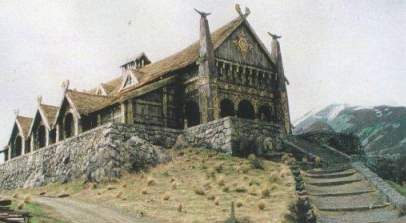
 ne has that person in their life. You know, the one you look up to. The one who can do no wrong. The one you trust that if all the world goes crazy, he or she will be right there, a consistent moral force to speak truth into your life.
 In Ephesians 2, Paul declares that we as Christians are the “workmanship of God”:
 A few weeks ago, I had the privilege of touring the Museum of Biblical Art in Dallas and discovered a beautiful painting by Botticelli titled Madonna of the Book. In the center of this piece sits Mary with the Christ child on her lap as they both read from a medieval book of hours, a sacred devotional text common to Botticelli’s generation. Noticeably, Mary is pensive, contemplative, and even mournful in her pose as she studies the book.
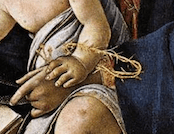 He was born to die. This is the will of God that “Jesus, delivered up according to the definite plan and foreknowledge of God, [be] crucified and killed by the hands of lawless men” (Acts 2:23). Indeed, Christ came into this world to “give his life as a ransom for many” (Matt. 20:28). As Mark Lowry famously wrote in a
 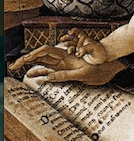 Yet, Christ guides her hand with His. “Keep reading. Keep reading.” Notice His left hand holding hers and His right hand guiding her back to the story. We must keep reading. Christ must die on the cross so that we must not. His steady and victorious look to His mother tells us everything. “I must do this for you,” he says to her and to us. “I love you. You must keep reading.” For as we keep reading, we discover that the story does not end at His death. In the words of the Battle Hymn, “Let the hero, born of woman, crush the serpent with His heel […] His truth is marching on.” He marches on. He marches on. Glory, glory, hallelujah.
 Eden.Babel