Here is my discussion of “School Poems” from The Cardinal Turns the Corner.
“School Poems”
The air in study hall was thick with the smoke of pencils,
Scribbling to find fire on the page, ten teenagers
Looking for love in the smile their words might make.
Over in the library, some have rolled their sleeves,
Bent over a row of screens,
Their hurried breaths gyrating the pinwheels of their poems
As their fingertips clicked like cleats on the pavement of their laptops,
Letters dripping on documents,
A thousand rain drops on an old tin roof.
I walked past the boy on the steps with a halo of reverb
Plugged in from ear to ear, connected to a phone synced to his heart,
Drumming his palms against his knees like his life
Had been lived only for this moment, the wild abandon
Of one who’d learned to walk the plank
As the pirates of passion loomed behind him with their thick beards
And blades sharpened
As if to say, “Rock this one out or you’ll sleep in the ocean.”
The girl in the courtyard crooked one leg behind the other,
Curling her fingers around her phone in the cold
Like she knew the next message he sent would make her warm.
So she bubbled her poetry in blue, mailed it on the airwaves, and waited for his ellipses,
Three dots in Morse before three words she longed to read.
Down the hall, the kindergarteners knelt outside their classroom,
Upturning waxy bags of crayon and a dozen safety scissors,
Peeling the ghosts of Elmer’s glue from their palms
As they told their parents they loved them
With a red construction heart and a firm crease in the center,
A greater declaration of devotion than any sonnet could ever sing.
So I kept walking briskly in the air of this century
Where people still write poetry, breaking pieces of their body
Like bread for summer swans
And pressing them deep into a dozen syllables,
The friction of pounding feet and chattering teeth
As they toss their own words into the rushing waters of time.
 In an age of rampant cynicism, intense narcissism, and deep defiance toward absolutes such as truth, goodness, and beauty, the ache for passionate and rich festivity must burn ever more feverishly in our hearts. This sour world, lost in the mirrors of its vanity and drowning in the white noise of feeds, posts, snaps, and late-night binges, is in dire need of a good feast, what Tolkien saw as an evening by the fire, filled with boisterous laughter and great dancing. Or, as Lewis saw, what greater way to herald the breaking of winter than the carousing of creatures at the coming of spring? The promise of resurrection is a great promise, full and strong, breaking like the tide against this screen-drunk land.

 A few weeks ago, I had the privilege of touring the Museum of Biblical Art in Dallas and discovered a beautiful painting by Botticelli titled Madonna of the Book. In the center of this piece sits Mary with the Christ child on her lap as they both read from a medieval book of hours, a sacred devotional text common to Botticelli’s generation. Noticeably, Mary is pensive, contemplative, and even mournful in her pose as she studies the book.
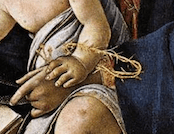 He was born to die. This is the will of God that “Jesus, delivered up according to the definite plan and foreknowledge of God, [be] crucified and killed by the hands of lawless men” (Acts 2:23). Indeed, Christ came into this world to “give his life as a ransom for many” (Matt. 20:28). As Mark Lowry famously wrote in a
 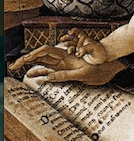 Yet, Christ guides her hand with His. “Keep reading. Keep reading.” Notice His left hand holding hers and His right hand guiding her back to the story. We must keep reading. Christ must die on the cross so that we must not. His steady and victorious look to His mother tells us everything. “I must do this for you,” he says to her and to us. “I love you. You must keep reading.” For as we keep reading, we discover that the story does not end at His death. In the words of the Battle Hymn, “Let the hero, born of woman, crush the serpent with His heel […] His truth is marching on.” He marches on. He marches on. Glory, glory, hallelujah.
 Eden.Babel