 A few weeks ago, I had the privilege of touring the Museum of Biblical Art in Dallas and discovered a beautiful painting by Botticelli titled Madonna of the Book. In the center of this piece sits Mary with the Christ child on her lap as they both read from a medieval book of hours, a sacred devotional text common to Botticelli’s generation. Noticeably, Mary is pensive, contemplative, and even mournful in her pose as she studies the book.
Several striking images arise from this remarkable portrait, particularly surrounding the event of Christ’s death on the cross:
1. The Cross
If you look closely, a crown of thorns and three nails adorn the left hand of Christ, signifying his coming crucifixion. The placement of these symbols around the arm of the infant Christ creates a powerful harmony and continuity in the picture, for we are able to see in a single moment both Christ’s beginning and ending simultaneously. 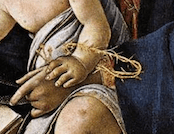 He was born to die. This is the will of God that “Jesus, delivered up according to the definite plan and foreknowledge of God, [be] crucified and killed by the hands of lawless men” (Acts 2:23). Indeed, Christ came into this world to “give his life as a ransom for many” (Matt. 20:28). As Mark Lowry famously wrote in a song to Mary: “This Child that you delivered will soon deliver you.”
2. The Gaze of Christ
Perhaps the most admirable feature of this work is the reassuring gaze of Christ toward His mother. As Mary appears somber, meditative, and hesitant to continue her reading (in a book which contains the gruesome account of the cross), the look of the Christ child is one of soothing comfort. “It’s okay, mother,” he seems to say, “we must keep reading the story.” Yes, we must. Mary, like many of us, nervously approaches the death of Jesus, the horrendous murder of her son. With pain she stays her hand to keep from witnessing the bloodshed. 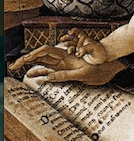 Yet, Christ guides her hand with His. “Keep reading. Keep reading.” Notice His left hand holding hers and His right hand guiding her back to the story. We must keep reading. Christ must die on the cross so that we must not. His steady and victorious look to His mother tells us everything. “I must do this for you,” he says to her and to us. “I love you. You must keep reading.” For as we keep reading, we discover that the story does not end at His death. In the words of the Battle Hymn, “Let the hero, born of woman, crush the serpent with His heel […] His truth is marching on.” He marches on. He marches on. Glory, glory, hallelujah.
3. Mary’s Garments
Interestingly, Mary is clothed in red (the shedding of blood for the covering of sin), and red is the garment closest to her heart. Draped around her and enveloping her entire figure is the blue of Christian baptism. Through the death of Christ, Mary is bought with blood and baptized into a new life, picturing the hope of Christ’s resurrection and the resurrection of the believers at His return. Though she is sad to think of His death, she is already clothed in His resurrection. Her joy is a future joy but a present reality.
4. The Dawn of Resurrection
Through the open window, we can just begin to glimpse the breaking dawn rising into view. “Weeping may tarry for the night, but joy comes in the morning” (Ps. 130:5). The death of Christ was a dark night, truly, but how glorious is His resurrection! “O Death, where is your sting?” (I Cor. 15:55).

“See, Mother, I make all things new.”
All in all, may we be encouraged that, though we tremble at times in our reading of the great story of God, faithless in our fear of the coming darkness, the hand of Christ bids us keep reading, for behold, He is making all things new (Rev. 21:5).
 Eden.Babel