The Poetry of God

downloadIn Ephesians 2, Paul declares that we as Christians are the “workmanship of God”:

“For we are his workmanship, created in Christ Jesus for good works, which God prepared beforehand, that we should walk in them” (Eph. 2:10).

Interestingly, just a verse earlier, Paul reminds us of the sobering reality that we are saved by grace through the gift of faith, not the strength of our own theological prowess or pull-myself-up-by-my-bootstraps, “can-do” optimism. There is no amount of self-help literature, meditative yoga, or American patriotism that can yank us out of the muck of our depravity. We are just plain sunk. Apart from him I can do nothing (John 15:5).

So how are we to read this declaration that we are God’s workmanship? If all the good in us comes from grace, what does this identity mean? Are we valuable? As Joe Rigney once said, “I know God loves me, but does He like me?”

It’s notable that the Greek word rendered as “workmanship” here in Ephesians is poiema, from which we can clearly see our English word poem. When Paul encourages the church at Ephesus that they are “God’s poiema” created “in Christ Jesus”, we must recall what the Apostle John called Christ at the beginning of his gospel: the Word (“In the beginning was the Word…“).

So, quite truly and wondrously, we are the poetry of God created by the Word of God. We are His poiema created in Christ Jesus for good works. One cannot help but remember the glorious image of the great lion Aslan, singing all of Narnia into existence, creating from nothing the majestic symphony of space, the living splash of Nature’s color, the taste of golden water and the scent of purple skylines. All of creation, with man and woman as its crown jewels, is woven together into a grand and passionately wild poem by the even grander and wilder God who penned it. The ink of God’s poetic effort is the living and breathing dreams and glories of man. We are God’s poiema created in Christ Jesus. Majesty upon majesty.

As David wrote in Psalm 19:

The heavens declare the glory of God,
    and the sky above proclaims his handiwork.
Day to day pours out speech,
    and night to night reveals knowledge.
There is no speech, nor are there words,
    whose voice is not heard.
Their voice goes out through all the earth,
    and their words to the end of the world.
In them he has set a tent for the sun,
which comes out like a bridegroom leaving his chamber,
    and, like a strong man, runs its course with joy.”

The poetry of God flames out through all the earth. Observe the fullness of His glory as it is declared in this passage: the sun comes out like a bridegroom, coming for his bride, running his course with joy. Every sunrise, then, is a beautiful picture of the Great Bridegroom pursuing His bride down the cosmic aisle of the skies and clouds, chasing after her well into the night (as every groom ought).

As Victorian poet Gerard Manly Hopkins puts it:

“The world is charged with the grandeur of God / It will flame out like shining from shook foil”

All of creation is charged with God’s grandeur, an electric livewire coursing deep into our veins. We are not a dull, lifeless poem, stuck in the pages of a bedraggled, spine-torn anthology in my English classroom. We are a living, spoken, adrenaline-pumping poem uttered by the very breath of God. We are His workmanship, His craft, the diamonds carved from coal, man from dust, woman from bone.

So, yes. God likes us. We are His poem. God passionately pursues us and love us because we are crafted by His hands and His Word, made in His very image. We are the clay of a dedicated, careful Potter. We are the rhymes and notes of a marvelous Poet. We are His workmanship, created in Christ Jesus. May we learn to live this way.

As Doug Wilson once noted, it is no wonder the first recorded words of human history were poetry: “This at last is bone of my bones and flesh of my flesh” (Gen. 2:23).

Prince Caspian and the Honourable Shame of Humanity

narnia-illustration-aslanToward the end of Prince Caspian, after the decisive battle for the Narnian throne against the usurper Miraz, Aslan relays to Caspian the story of his heritage to explain his rightful place as the true king of Narnia. His tale, however, is not filled with accounts of glorious kings and queens or daring adventures on the high seas (though Caspian will see plenty on the Dawn Treader). Rather, Aslan recounts stories of thieves, murderers, drunkards, pirates, quarrelers, and fierce tyrants. As Aslan describes this history, the young man’s face sinks into a deep sadness:

“Do you mark all this well, King Caspian?”

“I do indeed, Sir,” said Caspian. “I was wishing that I came of a more honourable lineage.”

What follows from Aslan is perhaps one of the most striking and insightful passages from the whole of the Narnia series:

“You come of the Lord Adam and the Lady Eve,” said Aslan. “And that is both honour enough to erect the head of the poorest beggar, and shame enough to bow the shoulders of the greatest emperor on earth. Be content.”

This keen and penetrating truth strikes at the heart of young Caspian, instantly quieting him (the next sentence simply states, “Caspian bowed.”). And, if we are reading correctly, it instantly quiets us. One can almost feel the warm, yet powerful breath of the Lion as he commands us to “be content.”

It is true that humanity is characterized by both the responsibility and privilege of bearing the very image of God. We are unordinary. Yet, in this account, we encounter the unbelievably weighty tension between being the jewel of God’s creation and being depraved sons of disobedience. We are both diamonds and dust. Being human is an honor and a shame.

How many of us, like Caspian, look around at our humanity and mourn our tattered lineage? How many videos of tiny fingers and legs in petri dishes can we stomach before we shake our heads in despair at what it has come to mean (or not mean) to be human?

But there, right there, Aslan instructs us to “be content.” In our vacillation between pride and despair, honor and shame in the human race, we must remember to be content. The Lord is sovereign. The Lord is King. Blessed be the name of the Lord.

Or, as Lewis would say, “Aslan is on the move.” Remember how The Lion, the Witch, and the Wardrobe concludes: the winter is thawing and it promises to be a real spring. Or, as Tolkien would have it, everything sad is coming untrue.

So while we face dark days in our humanity, ruefully wishing our story were more noble, we must bow our heads like Caspian and be content, not in our strength to withstand the coming evils but in the power and certainty of Christ’s victory over all things. Aslan assures Caspian because he has the authority to do so. May we learn to trust the King of kings in our honorable and our shameful days, for He alone will make all things new.

Bilbo Baggins and the Bravery of Willingness

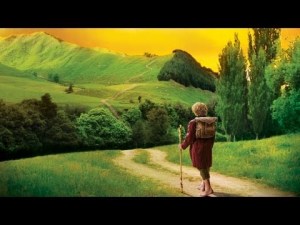
Bilbo BagginsIt is true that we are all characters in the great Story of God, called to our own journeys as we navigate the treacherous waters of a perilous world. It is also true that the dividing line between our actions in these journeys can be as thick as lead, the difference between noble Reepicheep, sailing into the majesty of Aslan’s country, and the self-absorbed Eustace, inching steadily toward the dragon’s den. Some are brave, some are weak.

So a natural question to come would be how we ought to prepare for the journeys we must take. What must I do to prepare for my task? How should I plan my journey? To the well-intentioned Christian, such questions seem righteous. Who doesn’t want to plan and execute an excellent journey for the sake of the Lord? Who doesn’t want to steel himself for the road ahead?

Yet, the answer to these questions is humbling and startling.

In the opening pages of The Hobbit, Bilbo Baggins is set up quite comfortably in his cozy life at Bag End. He has a drink, a smoke, and a crackling fire. Out of his window lie the fair hills of the Shire. His breakfasts and second breakfasts are hot and delicious. Yet, it is at this precise stage of his life that Gandalf and a hoard of dwarves descend on his home and change his life forever.

Bilbo was overwhelmingly unprepared, and in one of the most illuminating passages of the book, the narrator claims:

 “To the end of his days Bilbo could never remember how he found himself outside, without a hat, a walking-stick or any money, or anything that he usually took when he went out; leaving his second breakfast half-finished and quite unwashed-up, pushing his keys into Gandalf’s hands, and running as fast as his furry feet could carry him down the lane, past the great Mill, across The Water, and then on for a mile or more.”

The start of Bilbo’s incredible journey “there and back again” does not look like a carefully-scheduled trip with dried ink on the itinerary; Bilbo simply “found himself outside”, moving headlong into the mysterious dark ahead. Who are these dwarves? Where are we going, Gandalf? Will the road be dangerous? Will I live to tell about it? Questions flood his mind with no real assurances. Dwalin simply responds, “Don’t worry! You will have to manage without pocket-handkerchiefs, and a good many other things, before you get to the journey’s end.”

Unpreparedness, then, is the key note of Bilbo’s beginning, but it is not his readiness that is praised in the novel; it is his willingness. The remarkable quality of Bilbo’s journey is not in how excellently he mapped out his future but how bravely he faced it with a faithful willingness. Bilbo was not ready for his quest, but he was available for it.

If we were completely prepared for the journey we must take, would we be able to learn and see everything the experience could offer? Would our eyes be transfixed by the awe and wonder around us or would we lazily peruse our agendas and timetables for the next bulleted item? I imagine much of the significance and weight of our journey lies in the surprises in store.

So we, like Bilbo, must open ourselves to the bravery of willingness. We must reject the hesitance and fear that accompany so many of the plans we prescribe for ourselves. Bilbo was by no means prepared for his trek, but he was ultimately willing to accept it. He allowed himself to truly experience the situations he went through, concerned more with the nature of his path than the condition of his feet.

In my lifelong struggle to learn to pray, I pray that God turns my eyes away from self-absorption and worry to a noble willingness to see what He would have me to see and to take each experience with both hands, unashamed and unreserved. Such are the people that see the great things of God: the Moses that doesn’t stutter but shouts boldly, the Peter that doesn’t tread water but stands upon it, the Prodigal that returns for a job and finds a home, the Abraham that is called to a land he’s never known, and the Hebrews who must eat the manna of daily provision.

Though we may not ever be prepared for the turns our journey will take, we must be willing to step out into the darkness nonetheless. Just bear in mind we may have to leave our second breakfast half-finished.

Further Up and Further In

the-last-battle“I have come home at last! This is my real country! I belong here. This is the land I have been looking for all my life, though I never knew it till now. The reason why we loved the old Narnia is that it sometimes looked a little like this. Bree-hee-hee! Come further up, come further in!”

-Jewel the Unicorn, The Last Battle

“See, Mother”

Madonna of the BookA few weeks ago, I had the privilege of touring the Museum of Biblical Art in Dallas and discovered a beautiful painting by Botticelli titled Madonna of the Book. In the center of this piece sits Mary with the Christ child on her lap as they both read from a medieval book of hours, a sacred devotional text common to Botticelli’s generation. Noticeably, Mary is pensive, contemplative, and even mournful in her pose as she studies the book.

Several striking images arise from this remarkable portrait, particularly surrounding the event of Christ’s death on the cross:

1. The Cross

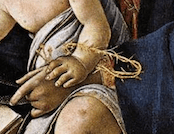
If you look closely, a crown of thorns and three nails adorn the left hand of Christ, signifying his coming crucifixion. The placement of these symbols around the arm of the infant Christ creates a powerful harmony and continuity in the picture, for we are able to see in a single moment both Christ’s beginning and ending simultaneously. Screen Shot 2015-07-07 at 1.33.41 PMHe was born to die. This is the will of God that “Jesus, delivered up according to the definite plan and foreknowledge of God, [be] crucified and killed by the hands of lawless men” (Acts 2:23). Indeed, Christ came into this world to “give his life as a ransom for many” (Matt. 20:28). As Mark Lowry famously wrote in a song to Mary: “This Child that you delivered will soon deliver you.”

2. The Gaze of Christ

Perhaps the most admirable feature of this work is the reassuring gaze of Christ toward His mother. As Mary appears somber, meditative, and hesitant to continue her reading (in a book which contains the gruesome account of the cross), the look of the Christ child is one of soothing comfort. “It’s okay, mother,” he seems to say, “we must keep reading the story.” Yes, we must. Mary, like many of us, nervously approaches the death of Jesus, the horrendous murder of her son. With pain she stays her hand to keep from witnessing the bloodshed. Screen Shot 2015-07-07 at 1.51.07 PMYet, Christ guides her hand with His. “Keep reading. Keep reading.” Notice His left hand holding hers and His right hand guiding her back to the story. We must keep reading. Christ must die on the cross so that we must not. His steady and victorious look to His mother tells us everything. “I must do this for you,” he says to her and to us. “I love you. You must keep reading.” For as we keep reading, we discover that the story does not end at His death. In the words of the Battle Hymn, “Let the hero, born of woman, crush the serpent with His heel […] His truth is marching on.” He marches on. He marches on. Glory, glory, hallelujah.

3. Mary’s Garments

Interestingly, Mary is clothed in red (the shedding of blood for the covering of sin), and red is the garment closest to her heart. Draped around her and enveloping her entire figure is the blue of Christian baptism. Through the death of Christ, Mary is bought with blood and baptized into a new life, picturing the hope of Christ’s resurrection and the resurrection of the believers at His return. Though she is sad to think of His death, she is already clothed in His resurrection. Her joy is a future joy but a present reality.

4. The Dawn of Resurrection

Through the open window, we can just begin to glimpse the breaking dawn rising into view. “Weeping may tarry for the night, but joy comes in the morning” (Ps. 130:5). The death of Christ was a dark night, truly, but how glorious is His resurrection! “O Death, where is your sting?” (I Cor. 15:55).

Screen Shot 2015-07-04 at 10.20.15 PM

“See, Mother, I make all things new.”

All in all, may we be encouraged that, though we tremble at times in our reading of the great story of God, faithless in our fear of the coming darkness, the hand of Christ bids us keep reading, for behold, He is making all things new (Rev. 21:5).

Goodnight Nobody

Goodnight Nobody

“Goodnight nobody”

So says Margaret Wise Brown’s narrator in the classic children’s book Goodnight Moon, a book that was read to me countless times as a child and is a favorite in the current rotation my wife and I are reading to our children. In the midst of the goodnights rendered to kittens, mittens, combs, brushes, and mush throughout the book, this particular sentence is quite startling.

I can’t help thinking of the phrase “Goodnight nobody” as one of the saddest utterances that many today unconsciously whisper as they lie down to sleep. Our American culture, so flooded by the New Atheism, is at war with the thought that there may be a God who built this ship and is sovereignly at the helm. They believe, as C.S. Lewis once did, that there is no God and they are mad at Him for not existing. As a result of this militant atheism, we have seen a noticeable rise in loneliness, meaninglessness, isolation, self-centeredness, and bitterness. Truth is no longer a concrete cornerstone but rather a confetti-gun explosion — everyone gets his own tiny piece of colorful “truth” upon which to build his house. And we all know what happens when the big, bad wolf blows on those houses.

To borrow an analogy from Douglas Wilson, the atheist’s creed is in accordance with John Lennon’s “Imagine”:

“Imagine there’s no heaven
It’s easy if you try
No hell below us
Above us only sky
Imagine all the people
Living for today”

There is no Heavenly Father for us to say goodnight to. Above us only sky. No eternal, sovereign justice awaiting anyone down here. Above us only sky. Above Dachau? Only sky. Above Ground Zero? Only sky. Above Syria? Only sky. We have certainly imagined, as Lennon desired, all the people living for today, and what we have gotten is a frenzied attempt to freeze time, to stay young forever, to be wealthy forever, to invest more in our online selves than our material selves. Our homes are selfish, our relationships selfish, our conversations selfish. We have exchanged the rod of Moses for the selfie stick of man. We are wound tight around our own axle, constantly getting what we have always wanted, and it’s making us so sad.

So when we lay ourselves down to sleep, we do not pray the Lord our soul to keep. We pray nothing. We say goodnight to nobody. When one of my daughters tumbles down and begins to cry, I swoop her up in my arms and softly say, “Daddy’s got you. It’s okay.” But for the modern atheist, he has no such comfort. For him, there is no cosmic Dad to hold onto, to cry to, to talk to. He has imagined Dad right out of the room and wonders why he feels so alone. He has shut his eyes tight to the notion of a Father God and questions why his world is so dark. In the ultimate analysis, his life is a blank page bearing the tragic inscription: “Goodnight nobody.”

As Shakespeare wrote, “All the world’s a stage, the men and women merely players.” We are all most certainly acting out a grand story (see my discussion of Hamlet). Yet, the atheist must also adopt the bleak words of the Player, the lead actor in a traveling theater troupe in Tom Stoppard’s great play Rosencrantz and Guildenstern Are Dead:

“You don’t understand the humiliation of it, to be tricked out of the single assumption that makes our existence bearable: that somebody is watching. We’re actors, we’re the opposite of people […] We need an audience.”

sisyphus_by_o__v-d66ox90If we are all actors in the cosmic theater of life, then the notion nobody is watching must be the most harrowing of all. Our tragedies and our triumphs would ultimately amount only to the enlargement or diminishment of the boulders that we, like Sisyphus, simply push up the mountainside. Unfortunately, the best the atheist can tell us in response to this horrendous thought is that we must imagine Sisyphus to be happy.

As Christians, we must constantly affirm the existence and presence of the Almighty God who not only created all things and sustains all things but cares for all things. Our lives have meaning because we are playing to His audience. We are seeking to glorify Him. We have received His divine approval. We have purpose. We are not marbles in a box, moving about aimlessly on this pale blue dot in the universe to no eternal or meaningful end. We are children of God. We say goodnight to Him as He lays us down to sleep. We are forgiven when we sin. We are raised to our feet when we fall. And when we come to die, we may echo the words of Christ and commend our spirit not into a blank oblivion but into our Father’s hands.

Stumbling into Symphonies

Symphony-piano-4639669-2560-1896In a conversation there are rules, and we all know them. Sometimes these rules are accidentally bent, supposing two people begin talking at the same time or no one knows just how to end it and walk away. Sometimes air lingers between the two people, causing an uncomfortable pause. Or maybe all the words blend into a unified sound of excitement as the two reunite in a frenzy of gushing phrases, tripping and spilling over each other’s hearts as they speak.

Often in these moments, something spiritual happens, like music. One gives and the other takes. One begins where the other ends. The excitement of one melts into the disappointment of another. When we speak, we work together, borrowing pieces of each other and weaving them into ourselves like toddlers rolling Play-Doh into multi-colored globes. In music, artists begin with a riff, a hook that seems compelling, and they play it over and over. Perhaps another will bring in a complementing piano line, and the drummer joins the jazz. Over time a conversation begins, a game of give-and-take that grows into a single song, each piece adding his share. As they work together, they sustain one another, each one holding the other to form a unified voice of music. As they play, they roll their unique colors and hues into a single shape, pulling together to the very center.

In this shared moment lies a spiritual truth, a beautiful truth of Christ that works like music. Like a conversation, our relationship with Jesus hinges on this back-and-forth, this dance. Yet, by no means is this relationship equal. As Jesus reaches out to us, we are drawn to His righteousness and perfect holiness. And as we understand our sinfulness, we call out to Him who saves. As C.S. Lewis writes in The Silver Chair through the mouth of the lion Aslan, “You would not have called to me unless I had been calling to you.” Jesus calls, and we are drawn; his calling gives us the power to call back. We, the prodigal sons and daughters, limp home, burdened, lonely, and beyond hope, simply to be met by our Father racing to meet us and hold us close, tears upon tears of highest joy. Our homecoming becomes a conversation, a living conversation in which the broken is repaired, the sad are filled with joy, and the end of our selfishness is the beginning of His grace. The Father calls to us, and we are welcomed home. We enter into a most gloriously unequal dialogue with the LORD, a vibrant relationship in which “He must become greater; I must become less” (John 3:30). A relationship with the Father “who did not spare his own Son but gave him up for us all” (Rom. 8:32). A Father “who gives us all things richly to enjoy” (I Tim. 6:17).

Like music, our salvation becomes our symphony. We offer our instruments, broken and tattered though they may be, and the LORD makes music. We give Him our fears and worries in prayer, and He provides peace and joy in return. In this conversation we learn to give ourselves wholly to Him, forever grateful that He gave Himself wholly to us.

The Brave Little Toaster (Discussion #1)

Since it is my birthday today, I thought I would commit a series of blog posts reacting to one of my favorite childhood movies, The Brave Little Toaster (1987). This movie is a Disney classic and filled to the brim with meaning and thematic resonance. It is at once both bleak and hopeful, hilarious and frightening. It is sad and redemptive. It is light and complex. It is wonderful.

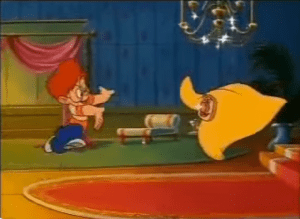
The movie follows five appliances (a toaster, a vacuum, a lamp, a radio, and an electric blanket) that have been left behind at an empty cottage by their “master.” Seeking to reaffirm their value and meaningfulness (their “function”, as they say), they set out on an epic quest to be reunited with their master and “plugged back in” to their essential purpose. In this post, I will consider the opening scene which constitutes roughly the first ten minutes of the film. If you have not seen TBLT, you may want to stop reading and check it out.

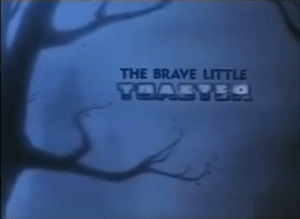
1. The Credit SequenceScreen Shot 2015-06-23 at 9.14.12 PM

The movie begins with looming strings and sparse piano trills in a minor key to create a sense of abandonment, bleakness, and despair. In this way, the music underscores the opening picture of bare tree limbs and grey, ubiquitous fog. This is a barren wasteland, devoid of life, light, and, as we will see, meaning. Notice the cold, mechanical font given for the title and the Gothic shadowing in the background.

Screen Shot 2015-06-23 at 9.15.30 PM

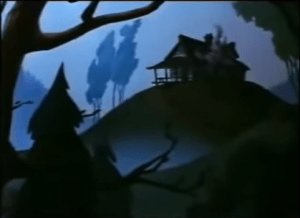
Yet, as the credits roll, the fog slowly lifts to reveal a lonely cottage on a hill, perhaps our single bastion of hope in this gloomy atmosphere. In the midst of the clouded valley, we see a home, even though it is shadowed as well. This is our first taste of a theme throughout the movie – the glimmers of hope within the surrounding darkness prod us to persevere in a world of betrayal, confusion, and emptiness.

Screen Shot 2015-06-23 at 9.27.13 PM

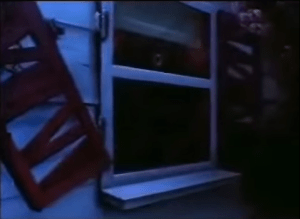
We then follow the camera as it zooms in to the cottage through a window (complete with broken, dilapidated shutters) and into the setting wherein we’ll meet our principal characters. It is key that the sequence moves from darkness to light as the sun rises during the course of this scene. It tells us that, though our characters are lost and sad, hope remains in the frame.

2. Light as Central Motif

Screen Shot 2015-06-23 at 9.30.34 PM

For a collection of household appliances, the concepts of power, energy, and light represent the essential life force. Being “on” is everything. As we have five appliances anthropomorphized for our main characters, we should assume references to “being plugged in” or “turned on” to be a central metaphor for both life (electrical energy) and purpose (function). As mentioned earlier, the idea of one’s function plays heavily in this movie as a symbol for one’s innate purpose. These appliances, like human beings, were designed to fulfill a specific function. Screen Shot 2015-06-23 at 9.51.32 PMThey were made for something. Yet, in this opening scene, we see each of them longing to be used, to be needed, to be fulfilled, with no “master” there to answer their quiet pleas for meaning and purpose.

So in this scene, we must notice how the image of light interacts with each character. Currently, they are all darkened, so to speak, dormant and devoid of purpose. Even Lamp, ironically, mentions the fear of this situation throughout the scene (“Who turned out the lights?” // “I hate being left in the dark” // etc.) Yet, light shines on each character momentarily. This brief glimpse of light affords the viewer a sense of hope that perhaps each of these characters may yet be reunited with their master and returned to lives of design and function fulfilled.

3. “A Tale Full of Sound and Fury”

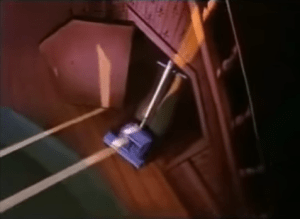
Screen Shot 2015-06-23 at 9.54.55 PMScreen Shot 2015-06-23 at 9.55.55 PMOne of the most striking elements of the opening scene is the strict routine our characters keep in maintaining the cottage for their master. Even though it has been, as Kirby the Vacuum puts it “2,000 days” since the master has been there, they work diligently to serve their purpose to a deserted audience. Kirby relentlessly cleans every speck of dirt on the floor, Radio entertains an empty room, and Toaster toasts…nothing. This is the despair of absurdity, the grief of discovering that in the great play of life, there may be no one watching. As Macbeth famously declares:

“Out, out, brief candle!
Life’s but a walking shadow, a poor player
That struts and frets his hour upon the stage
And then is heard no more: it is a tale
Told by an idiot, full of sound and fury,
Signifying nothing.”

Screen Shot 2015-06-23 at 10.33.02 PMInterestingly, we get a quick image of such a “walking shadow” as Radio plays “Tutti Frutti” to begin the cleaning chores, which, ironically, are meaningless without the master at home.

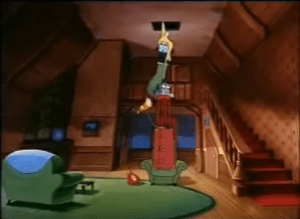
Just before the cleaning montage begins, however, the appliances descend into full blown chaos. Without a master around and without any inherent purpose, havoc inevitably ensues (for appliance and human being alike). Radio and Lamp are fighting, Blanket accidentally smothers their duel (after having literally descended down the handrail, itself an appropriate symbol for the Fall), and Kirby unexpectedly vacuums up all three. It remains for Toaster, the leader of the pack, to fix everything. But to what end? Why should they get to work? No one’s home.

Once the disorder has subsided, Radio asks Toaster, “So, what’s in our lineup for today?” to which Lamp echoes, “Yeah, what are our instructions?” Again, we see a desire for purpose, for instructions given by a master to follow. This should not be seen as advocating any sense of mindless obedience without will. This is not a case of simple puppetry. Their longing for instructions to follow coincides with their longing to fulfill their function. They all self-evidently have a purpose and design, and following the right instructions leads to the fulfillment of that purpose and design. Notice how this speaks to us. We also have a specific purpose and design to carry out, and we long for our Master to give us our instructions. We all ought to wake up and ask the same question: What should I do to fulfill my purpose?

As Blanket moans, “I don’t like to work without the master.”

Exactly.

4. Longing for Master

All the cleaning suddenly halts as Blanket thinks he can hear a car coming down the road. Instantly, all of our characters rush furiously to see if the rumor is true. Is the master coming home? Could it be?

Screen Shot 2015-06-23 at 10.45.35 PM“A CAR!” they yell, filled with the hope of purpose. At last, our master is home! They scramble around the cottage for anything they can find to reach the attic window, their best chance to catch a glimpse of the master’s homecoming. They work together, reaching up to heaven to see the master.

Once Blanket reaches the window, he imagines the splendor and joy of what it would be like to see his master again, to be held and loved by him. Screen Shot 2015-06-23 at 10.52.54 PMThe master bursts through the door in full and shining glory, arms out to welcome his weary and wistful friends, “Home, Sweet Home” lovingly pinned to the wall. What a picture of God and the beauty of the great Homecoming. The glorious moment of being reunited with our Master, our longing for purpose fulfilled, our existences meaningful once more.

Screen Shot 2015-06-23 at 10.54.14 PM

Screen Shot 2015-06-23 at 10.55.53 PM

Yet, at the height of this fantasy, the master becomes a mirage, and our characters bitterly return to their meaningless labor. Like Waiting for Godot, it seems the master will never come down the road, watch and ache though his appliances might.

We close this scene with Radio’s sorrowful broadcast:

“Sorry for that little interruption, folks. We return to our regularly scheduled program at this time.”Screen Shot 2015-06-23 at 10.57.22 PM

The hope of the master’s return has been dramatically reduced to merely a “little interruption” as our characters return to their insignificant, “regularly scheduled” work.

We must observe the fall from harmony and purpose that has taken place here. These characters have become disconnected from their Master and their individual functions. They are lost, reaching and hoping for a master to come home and revive them. What a picture of the Fall from our Created Design! We, too, were made for a purpose with a Master who loves us. And we are desperate for Him, frantic for meaning in our empty cottages. We must notice the dreariness and futility of a life spent fervently at fruitless work for a master who may never show up. Their faith, however, is ardent; they dare not give up hope that their Master is out there and their existences are meaningful.

Stay tuned for Discussion #2!

Pollute the Shadows

While attending the ACCS conference in Dallas, I was quite struck Thursday morning by a powerful quote from N.D. Wilson that was referenced during an early plenary session. As it regards the nature of the world around us and our task to engage with that world armed to the teeth, I thought it appropriate to include here:

“The world is rated R, and no one is checking IDs. Do not try to make it G by imagining the shadows away. Do not try to hide your children from the world forever, but do not try to pretend there is no danger. Train them. Give them sharp eyes and bellies full of laughter. Make them dangerous. Make them yeast, and when they’ve grown, they will pollute the shadows.”

-N.D. Wilson, Notes from the Tilt-A-Whirl: Wide-Eyed Wonder in God’s Spoken World

Five Influential Writers in My Life

As I am working to lift Eden.Babel onto its feet, one of my primary concerns and interests is in the field of wordsmithing. Excellent craftsmanship is a noble goal, no matter what the smithy of your particular ilk is filled with; the mason may use bricks, the painter his brushes, the musician his notes. The writer uses words. Since the usage of words is a staple of most people’s daily living, the writer has a peculiarly interesting challenge before him. Not everyone uses paint or notes or bricks in the course of their 24 hours, but we almost all use words. Some may wish others used fewer, but that’s another post. Writers are tasked to take a seemingly mundane feature of our existence (words and their arrangement) and spin them in such a way that they can knock a hearer off his or her feet. As Mary, Queen of Scots once said of John Knox, “I fear his tongue and pen more than the armies of England.”

As I have immersed myself over the years in the world of literature, poetry, and many other forms of the written word as well as committed myself to the weaving of my own words, I have decided to consider five of the most influential writers in my own life. This list, as with most lists of its kind, is written in the current moment, meaning I am quite available to be moved and impacted by other writers than these five in the future just as I certainly have been in the past. Also, this list does not factor in God and His Word, the most influential book ever written. As a Christian, I heartily affirm the influence of the Word of God to be a given.

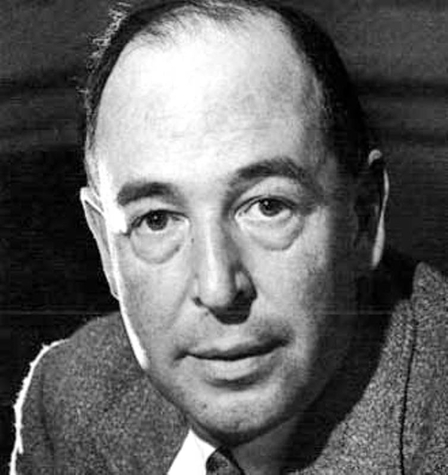
5. C.S. Lewis

cs lewis

This choice really stems from how much of Lewis I have read over the past ten or so years. As a child, I was raised on the Narnia stories and have just recently started to go back through them. I was likewise raised on the BBC films of the Narnia books (you know, the Lucy with her wonderful teeth, the giant beavers, the animatronic Aslan. Classics…). As I moved into college, I began to wade through more of Lewis’ work, including The Great Divorce, Till We Have FacesThe Screwtape Letters, and others. During a bleaker period, I picked up A Grief Observed, which was very helpful. Finally, while studying literature in grad school, I took a course on Lewis and Tolkien in London. There, I dove headlong into his space trilogy, The Four LovesThe Weight of Glory, and a great deal of his biography. Since then, I’ve read Surprised by Joy, a number of his poems, and continue to read him more and more. His commitment to both logic and fancy is contagious, and I look to him for an abundance of insight and imagination.

Recommended readingOut of the Silent PlanetThe Voyage of the Dawn TreaderThe Screwtape Letters, “The Future of Forestry”, “Meditation in a Toolshed”

4. Billy Collins

Billy-Collins

In compiling this list, I made an effort to select writers that represent different genres and approaches. With this in mind, Collins is certainly my poetic choice. He served as poet laureate for the U.S. in the early 2000s, and I even had the privilege of meeting him at a poetry reading in Nashville. Collins’ poetry is known for its accessibility, humor, and seeming simplicity. For this, he may certainly be termed a poet of the people. Yet, his writing is elusive, deep, biting, startling, and some of the most moving verse I’ve encountered. Collins has the unique ability to take a simple reality (weighing a dog, weaving a lanyard at camp, studying geography) and transform it into a transcendent experience as he observes the fullness of feeling, sensitivity, and power that can exist in any given human moment. He treats love, loss, friendship, fear, and longing as though they are old pals, conversing freely with them over coffee at midnight. He laughs through awkwardness and shudders at morning light. He can turn any event on its head at the start of a single stanza and leave you breathless upon completing it. I cannot speak highly enough of his work, and I have thoroughly enjoyed making my way through his collections.

Recommended reading: “The Lanyard”, “Weighing the Dog”, “Introduction to Poetry”, “Plight of the Troubadour”

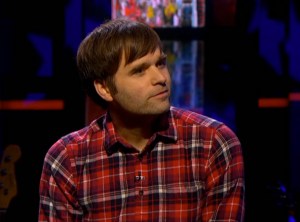
3. Ben Gibbard
gibbard-colbert

Though he is primarily regarded as a musician, Gibbard’s lyric writing ranks right up there with the best of them. He is the frontman for the indie rock band Death Cab for Cutie and has become a respected voice for poetic melancholy in our generation. I caught on to Ben Gibbard’s beautiful writing when I was first introduced to DCFC’s album Transatlanticism by my little brother, Chris. I remember being immediately struck by the quality of their music and Gibbard’s soaring melodies, so I decided to go through the whole album several times over on my own. What I discovered as I walked alongside his verses and choruses, acutely attuned to the narratives he was singing, was simply breathtaking. I was speechless. Gibbard could weave a lyrical phrase unlike anyone I had ever heard, and what had ignited a glimmering flame of attraction and sympathy for him in Transatlanticism was fueled to a wildfire in Plans, their 2005 album. By this time, I had begun playing music myself with a friend of mine and had become interested in lyric writing as a form of expression not dissimilar from poetry. As I delved further into writing music and writing lyrics, Gibbard always served as the standard, the pitch in which all of my own writing was set. To this day, I look to Ben Gibbard’s poetic sensibility, astounding mastery of metaphorical language, and sobering emotional melancholy for a bracing dose of creative power to shock me back into my own love and passion for writing.

Recommended reading/listening: “What Sarah Said”, “Brothers on a Hotel Bed”, “Little Wanderer”, “Transatlanticism”, “We Looked Like Giants”, “Title and Registration”, “Summer Skin”, “No Room in Frame”

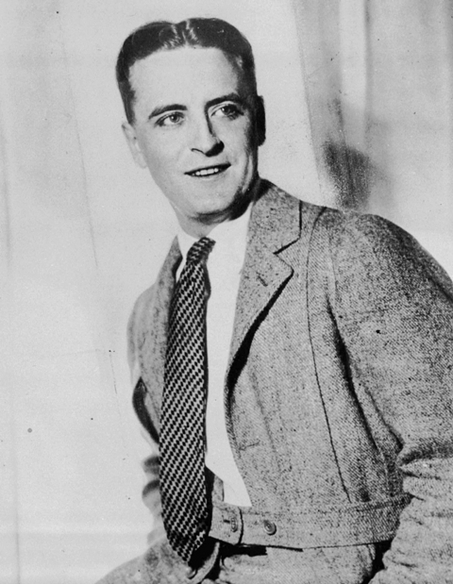
2. F. Scott Fitzgerald

f-scott-fitzgerald

If you are reading this and you are a former/current student of mine, you saw this coming; I tend to reference Fitzgerald all the time in class. Simply put, there will never be another F. Scott Fitzgerald. I dedicated my master’s thesis to the life and work of this marvelous author, so I am quite biased. I do believe, however, that his prophetic understanding of American narcissism, the nature of sin, the transience of happiness, and the ache of unrequited love have cemented him in literary history as a true icon of the highest caliber. He was painfully romantic, given over at once to both the beauty and the hopelessness of his dreams. He desired a greatness that would always be two steps ahead of him, doubting his ability to reach it yet straining forward all his life. He was exuberantly happy and painfully miserable. He rose meteorically and fell disastrously. He fought with God and embraced God. He could dash off a crowd-pleaser in a matter of hours (often hungover) and labor meticulously over a failing novel for years. And his writing is simply magnificent. Every page of his work is filled with both diamonds and dust, champagne and charlatans. He wrote like Mozart, lyrically effusing phrases and sentences that seemed like they had been written ages ago as he simply pulled them out of the air and blotted them on paper. He wrote like most men breathe, pouring forth what was already in there, effortlessly. Much of my love for the imaginative wonder and hope in life is credited to his work. I will read him until I can no longer read.

Recommended readingThe Great GatsbyThis Side of Paradise, “‘The Sensible Thing'”, “Thank You for the Light”, “The Cut-Glass Bowl”, “The Jelly-Bean”

1. Doug Wilson

Doug-Wilson

Doug Wilson is a theologian, pastor, and highly prolific writer with dozens of books to his name. If there is any writer who has helped shape my thinking, provoke my curiosity, satisfy my imaginative scope, push my pursuit of excellence, hone my understanding of joy, and confirm my desire for the full, abundant, passionate life in Christ, Doug Wilson is that writer. His work ranges greatly, covering such topics as culture, theology, rhetoric, argument, marriage, childrearing, father hunger, eschatology, apologetics, creative writing, Beowulf, wisdom, the Middle Ages, hearty laughter, Calvinism, gratitude, poetry, robust singing, and much more. His writing has led me deeper into the conviction that God is God and God is good. I am so deeply indebted to his writing and his teachings on the Christian life that to remove his influence from my life would be to remove a great deal of who I have become in my faith in Jesus. While the content of his work is overwhelmingly edifying and helpful, his style is simply inimitable. He wields the English language like a battle axe, sharp at the edge and effective in every blow. He is clever, witty, incisive, kind, colorful, lyrical, and quotable. He is memorable, humorous, startling, paradoxical, and charming. He is jolly and forthright. He is happy and rigid. In a word, he is full. My admiration and respect for Wilson’s writing cannot be expressed enough, and I could speak at greater and greater lengths in praise of his command over the written word.

Recommended readingHeaven MisplacedAngels in the ArchitectureRules for ReformersJoy at the End of the TetherWordsmithy, God Is