A Quiet Pond in Camden

My wife’s grandfather passed away a few days ago, and his funeral is this morning in South Carolina. This poem is in honor of Elbert Benjamin Newman, Sr. 


I couldn’t help but notice your hands first, Granddaddy,

Your nails yellowed by coarse decades of work,

Your veins the color of wine.


Against the white cloth of your rolling hospice bed

They seemed translucent, thinning from the groan of

Fluorescent light.


They’ve worn age well, these spotted hands,

Covered in the creases of your full life,

And I admit I laughed a little when your great-grandkids

Scooted close to say hello,

And you peered through the bifocaled tunnel of time

To smile back and twinkle two fingers

As best you could.


But when you winced and adjusted the tape on your bruising skin,

Scratching the IV in your limp fist,

I wanted to run out of that hospital,

Down the front, tightly-manicured lawn,

And leap into the clouds to see your life in sum,

Every living scene all at once.


I wanted to see those hands wriggle a ring on Grandmama’s finger,

Twist the ripcord of your parachute in the War,

Peel a hundred avocados, stranded in the Philippines.


I wanted to see you vote for Stevenson in ’52,

Build a furniture business with the strength of your iron will,

Raise a nurse, a preacher, and an heir to your company,

Then see your lineage expand

As generations branched and took your torch into the future.


I wanted to see your hands cradle each and every grandchild,

Each and every great-grandchild,

As you breathed in the lily air of new life.


I wanted to see your hands take up the fork and knife

And silently thank Grandmama’s every move with your cutting,

Pancakes, chicken, pie, and all her other glories,

Then gulp your gratitude after swishing sweet tea

From cheek to cheek.


They’ve worn age well, these spotted hands

That pulled me back down from the sky of my daydreaming

As if to say it’s time.

And it is.


So let us all smile and say goodbye, Granddaddy,

Loud enough for you to hear,

As we crowd around your recliner in our minds

And carry your legacy forward

Into another hundred years and more,

Speeding ever faster from a quiet pond in Camden.

Grief

Another poem…


As I write this,

I’m still breathing hard from a night of fitful sleeping,

My V-neck shirt clinging like dew to my warm chest

While the ceiling fan does its best to gin up

A gentle wind.


It’s, let’s see,

I’ll need my glasses for a bit,

2:38 in the morning,

And I’m jotting down my thoughts at the bedside table

Like the doctor said.

Oh, and my feelings,

I’m also recording my feelings.


The poetry’s been difficult these days.

It doesn’t flow like it once did.

The Nile’s all dried up, you’d ask,

Or turned to blood in plague? And I’d chuckle.

I tried some in the first stanza with the sweat simile,

But I think I yawned in the middle of it.


I remember you used to love a haiku I once wrote

About the cold side of the pillow

(Sort of on the fly, just to see you smile really).

Only now do I see why you liked it so,

As I cycle and recycle this old feather bag

To find that cool shadowy feeling in which to lay

My weary head.


It’s only when I glance over at yours in its pristine condition,

And I notice no sagging indention in the center,

That I remember your pillow is always cool now,

Both sides.


So, I’ll just lay my glasses back down on the nightstand,

At 2:52 in the morning,

And I’ll climb once more into my tempest of dreams

Where you and I are together again,

If momentarily,

And somewhat wispy in our world of memory,

Before my body shakes awake

At 3:41 AM,

And I lean for my pencil

From my sloppy and disheveled side of the bed.

Clean Slate

I’d like to introduce my guest writer for this post. Will O’Neal is a current student in my Creative Writing class and a truly remarkable young poet. His wordmithing talent and his imaginative reach are quite impressive, so I asked if I could share his most recent poem “Clean Slate” on Eden.Babel…

Enjoy. 


With one fluent swipe of a hand, it’s gone

Non-existent

It was an idea, then breathed into creation

Now forever obliterated.

With one careless fling of an arm,

It was all destroyed

With nothing left, except the faded view

Of what it once was.

It’s ironic they call it dry

‘Cause of all the rich and wonder-drenched ideals

That were swept aside

All the emotional words,

And Truth-filled phrases

Erased and turned to blackened and lifeless ashes.


If only we could amplify it to a larger scale

Patch up, erase, and destroy our mistakes and blemishes,

Perfect our lives

So that we seem pristine

As newborn children,

In all their innocent infancies

Wipe our slate clean

So that we are perfectly polished, Photo-shopped people

Hiding behind a facade of fantasized features

But then without our mistakes,

We all become the same,

A utopian human race.

Our faults are what set us apart

And how we handle them is what defines us

So let’s not destroy our mistakes;

Just learn from them,

And leave the Dry Erasers for Expo Markers

And games of Hangman.

On Reading Kafka’s The Metamorphosis

“When Gregor Samsa woke up one morning from unsettling dreams, he found himself changed in his bed into a monstrous vermin.”  Franz Kafka, The Metamorphosis


I drove home from school that evening,

My bag sprawled against the passenger seat,

Rain raking across the windshield,

And I mulled maddeningly over his opening line.


Poor Gregor, I thought,

It’s bad enough to endure

Unsettling dreams,

But to wake up one morning only

To find yourself transformed into a

Monstrous vermin…

What a way to go.


Then, as I drifted into my driveway,

I began to question the very nature of change.

The Metamorphosis, it’s called,

He awakes to find he had become

Something else entire.

Clever, but simply fiction.

No early morning spontaneous change for the rest of us in the

Real world.


I continued to ponder Gregor’s condition

As I walked through my kitchen,

Kissed my wife,

And knelt to the floor of my living room to tussle with my daughters,

To release the hours of giggling from the depths of their little lungs,

To wage another campaign in the infamous Tickle Wars.


I had almost forgotten Kafka’s novella

And Gregor’s plight,

When my oldest had settled her spurs in the floor

To summon her favorite horse for a quick saunter around the house.


As I bent to my hands and knees,

Lowering my back to help her saddle up,

I remembered the magic of change, the invisible truth that

Swells within the blood of fathers,

For all my philosophies and empty questions

Faded into shadow as my fingertips hardened to hooves,

Thick as iron,

And my mouth began to dribble the dabbled joy of stallions.


It was then,

As the cool carpet sprang forth with grass,

And the dusty wind howled through our TV screen to breeze across

My daughter’s laughing chin,

That I believed again in metamorphosis,

And I neighed loud enough to stay the dawn

And send Gregor back to sleep.

Together

A poem for my daughter, Julianna…


In the dream,

You and I were seated,

Side by side,

In the bench seat of a borrowed golf cart,

Touring the cracks and

Sparkling asphalt of our neighborhood

As the sun began to set.


Together,

We hummed through the endless turns

And quiet stretches,

Never bothering to circle back

(if that’s what one does in a winding subdivision),

And I laughed as your cheeks tightened

From smiling

And your blonde hair giggled in the wind.


I think we drove for hours,

You and I,

Always whirling around another corner,

Discovering the horizons that lilted with purpled light.


“Daddy,” you sang.

“Yes, Julie?”


I looked over at you

And your bouncing knees,

Clapping hands,

As you climbed the little ladders in your eyes,

Gazing into futures,

Wondering,

Eyelashes swept with spring.


The warm pull of our small motor

Rose into the sky

As you colored the clouds with your singing,

Like fingerpaint against infinite sheets

Of 97¢ construction paper.


“Daddy,” you sang.

“Yes, Julie?”


But then,

Slowly,

Our magic cart

Reached the end of the dream,

Our swirling atmosphere slurred to a stop

Like chalk,

Our wheels sticking on the fermata,

The song sustaining, the pedal dampened,

As my brain began to wake my body.


“Daddy,” you sang.

“Yes, Julie?”


I stumble through the early light

To open your bedroom door.


“I love you,” you sing.

“Good morning, Julie,” I respond,


And we both hear the click of the

Automatic coffee maker,

Heralding the dawn,

As we walk down the morning stairs


Together.

Idolatry

A poem on idolatry and repentance…


I stopped in silence on the corner,

Marveling,

As I watched Superman stumble out of the bar,

His eyes emptied of their stars and stuttering

With six glasses of Kryptonite.


He swung his strong arm around the street lamp,

Guffawed a wet vomit on the sidewalk,

Then hacked his spit back through his nose to burn his lungs.


Passers by halted as he threw up again,

His x-ray vision malfunctioning, now

A sterile gaze frantic for the trash bin.


With his left hand, he clumsily groped for his red cape

To wipe the mealy puke from his lips,

And the ladies on the corner softly covered their own mouths in shame.


We noticed his look had lost that Clark Kent cut,

The sharp and dapper face of a hero, and his cheekbones,

Once formed by flight,

Now stubbled lazily as his dingy suit glinted in the moonlight.


But as he bent over the trash can to ready himself for more wrenching,

I knew then what I must do,

What we all must do.


The crowd stared as I wrapped my arms around his neck,

Hugged our feeble god,

And pulled his cape knot tight against his throat

With all my evening strength.


One by one the audience faded away,

Abandoning the suffocating drunkard,

Bearing the startling truth that

We lose the things we idolize

And must choke the things we cherish most.

Ray’s Peaches

Another summer poem…


Our tires chewed the gravel road,

Tossing rocks into the palm of a single beam of sunlight

As we pulled the car crookedly into his driveway.


He sat enthroned in the yawning wood of his tumbledown rocking chair –

Still as the stale air of his ripening trees,

The former glory of Ray’s Peaches.


The A-frame sign by the old highway

Had lost two letters from the downpours of time,

The decay of decades, remainders from rain

And the Carolina sun,

The ghostly silhouette of the first and the second e

Unveiling the bright white of the untanned parts

And a vacant apostrophe near the top.


Ray watched as my family and I leapt from the car

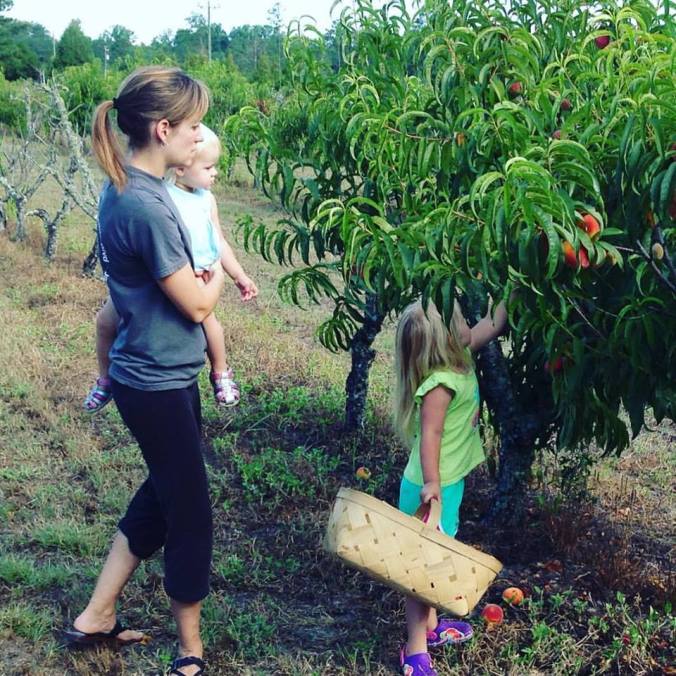
And asked for a couple baskets for the peaches,

His freckled grin brawling against the worn grooves

Of his cheeks, and his eyes still laughing like the sky.


That morning,

We plucked our swollen wonders,

Warm as hands,

And kissed the gentle clouds with our giggling.


Ray simply watched as we lugged our teeming baskets to the scale,

Fifty cents a pound, peaches discounted

As a favor to the family grandfathered by the town preacher.

He felt the sharp cool of dollars between his thumb and finger

And winked at my daughter, quick enough to only spill

A flutter of magic at her dancing feet.


And as she paused to glance at Old Ray

Of Ray’s Peaches,

She lay her basket in the grass and scooped the smell of earth

Into her little hands,

Thanked Mr. Ray for the fruit,

And turned with her clasped fingers toward the car

While Ray lifted a prayer to God

That Elizabeth may turn her eyes down from heaven

To their small peach farm once more

As he kissed the gentle clouds

And shuffled to their bed to sleep.


13615208_884782098526_6764067680600471414_n

The Decade of Literary Explosion: 10 Books in 10 Years

In my previous post, I mentioned that I was making my way through Dostoevsky’s Crime and Punishment, a novel of intense psychological depth, gripping suspense, and captivating revelations of the dirt and poverty of man’s depraved being. Truly, apart from Christ we can do nothing, and Crime unflinchingly exposes this theme in the barren alleys of 19th century St. Petersburg.

Simultaneously, I have been watching the 25th anniversary concert of Les Misérables with my daughters. We happened to listen one day to “Look Down” – the opening number with Javert and the chain gang – and my girls loved it, asking to hear it over and over. Soon enough, we watched the concert together, and my girls were asking for Jean Valjean and Fantine; just yesterday, I caught my eldest singing, “24601!” Needless to say, we have all been entranced.

So as my reading has been tunneling the streets of St. Petersburg with Raskolnikov and my listening has been building barricades with Enjolras and Marius, I’ve felt my mind begin to consider similarities in theme, tone, and pathos between the two works. I am hoping to dedicate a future post to investigating such a comparison.

For now, I was further struck by the fact that both works were published within about five years of each other. Looking further, I began to notice that the decade of the 1860s was an extraordinary era of literary flourishing as grand masterpieces erupted from America, England, France, Russia, and many other countries. The foundation had already been set in the previous decade with the impressive publications of The Scarlet Letter and David Copperfield (1850), Moby Dick (1851), Walden and Hard Times (1854), Leaves of Grass (1855), Madame Bovary (1856), and A Tale of Two Cities (1859). Yet, one sees from 1860-1869 a truly magnificent development in literature as groundbreaking works nearly toppled on top of each other, signaling one of the brightest hours in literary history.
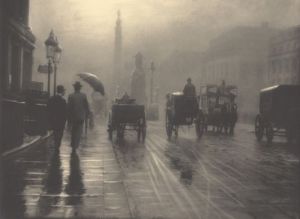
Victorian LondonThis list is unbearably narrow, meaning that the work of contemporaries like Matthew Arnold, Charles Spurgeon, Ralph Waldo Emerson, Henry Wadsworth Longfellow, Alfred Tennyson, and Abraham Lincoln are criminally unmentioned.

First, in 1860, we see the serialization of Charles Dickens’ greatest novel Great Expectations beginning, culminating the following year in 1861. This novel, a bildungsroman and the second of his to feature a first-person narrator, would ultimately become his finest triumph, chronicling the tempestuous life of Pip Pirrip as he navigates the artificiality of the upper classes in London and discovers the hollowness of his own ambitions in the process.

Next, in 1861, George Eliot publishes her moral allegory Silas Marner, a short but enchanting account of loss and salvation through the memorable appearance of little Eppie Marner to the hardened home of the title character.LesMis-main
In 1862 across the channel, beloved French author Victor Hugo publishes his sensational goliath Les Misérables, the story of Jean Valjean, “the weeping criminal”, as he struggles to accept and redistribute the grace and mercy of a loving God.

In 1864, Dickens returns to the writing table to pen his penultimate novel (and the last completed one before his death in 1870) Our Mutual Friend. Meanwhile in the cold heart of Russia, Fyodor Dostoevsky writes his brief, yet harrowing account of the underground man in Notes from Underground, a turbulent and strikingly honest account of a “sick and spiteful man” working out his pain and suffering in dreaded isolation.

maxresdefaultOn a lighter note (…possibly, depending on your interpretation), Lewis Carroll publishes his famous work Alice’s Adventures in Wonderland in 1865, and readers everywhere have been led down the rabbit hole ever since.

On a certainly darker note (…again, possibly, depending on your interpretation and your overall personality), Dostoevsky sees the overnight success of his 1866 novel, Crime and Punishment. Who knew an axe murder could be so philosophically intriguing?

Back in America in 1867, Samuel Langhorne Clemens, better known as Mark Twain, publishes his first book, a collection of short stories titled The Celebrated Jumping Frog of Calaveras County. Twain would go on to write The Adventures of Tom Sawyer and The Adventures of Huckleberry Finn; of the latter, Ernest Hemingway claimed, “All of modern American literature comes from one book by Mark Twain called Huckleberry Finn.

In 1868 another American classic arises: Little Women by Louisa May Alcott. While Twain’s writing would bring light and recognition to the American south, Alcott’s did the same for New England, depicting the power of domestic drama and the fierce bonds of sisterly affection and love. Except when Amy tossed Jo’s manuscript in the fire. Gracious.

Lastly, in 1869, and merely three years after the appearance of Crime and Punishment comes Russia’s other hulking giant: War and Peace by Leo Tolstoy. If the 1860s were a lineup, Russia may just be batting cleanup with Tolstoy and Dostoevsky publishing a combined 2,000 pages of literary strength. So much snow.

So there you are; ten impressive contributions to literary history in just ten short years. I’m sure Queen Victoria was thrilled… if she could be bothered enough to actually smile.

Happy reading!
“Come Forth, Ye Drunkards”: Pity and Grace in Crime and Punishment

raskolnikov 3I am working my way through Fyodor Dostoevsky’s Crime and Punishment and was struck by one of its early scenes depicting a drunkard in a St. Petersburg tavern bemoaning his vices, as well as the costs they have accumulated, to the novel’s protagonist Rodya Raskolnikov.

To set the scene, Marmeladov is a sickly alcoholic who has drowned himself beyond the breaking point in his sins. With each vain attempt at repentance, Marmeladov, like a dog to his vomit, returns again and again to his excesses, much to the despair and fury of his long-suffering wife and children.  In fact, Marmeladov mumbles to Raskolnikov that his drinking has even pushed his daughter Sonya into prostitution to keep the family above water while he lurches night after night down the old steps into the dingy bar.

In his extensive monologue, Marmeladov admits his depravity and the egregious consequences it is creating, yet he feels compelled to linger in his darkness, a tension that pits sin and redemption on opposite ends of the same locked door of the heart, thus foreshadowing Raskolnikov’s own division as he crouches behind the door of the old pawnbroker moments before her murder.

By the end of his rambling speech, however, Marmeladov rises to a momentous occasion in which he declares he “ought to be crucified” and judged rightly for his wickedness. He even tells the bartender: “Do you suppose, you that sell, that this pint of yours has been sweet to me? It was tribulation I sought at the bottom of it, tears and tribulation, and I have found it, and I have tasted it.”  Here, Marmeladov has reached the nadir of his troubles and has realized his inability to see joy, redemption, or hope in his bottomless search; neither in beer nor the tears it draws can salvation be found.

At the climax of his speech, Marmeladov looks forward to the final judgment of Christ in which all will be exposed and all will be made right. Read the beauty of his plea:

“And He will say, ‘Come to me! I have already forgiven thee once…Thy sins which are many are forgiven thee for thou hast loved much’ […] And when He has done with all of them, then He will summon us. ‘You too come forth,’ He will say, ‘Come forth ye drunkards, come forth, ye weak ones, come forth, ye children of shame!’ […] And the wise ones and those of understanding will say, ‘Oh Lord, why dost Thou receive these men?’ And He will say, ‘This is why I receive them, oh ye wise, this is why I receive them, oh ye of understanding, that not one of them believed himself to be worthy of this.'”

Few moments in literature parallel with this piercing declaration of hope in the face of hollow living. Marmeladov, for all his sinfulness and despair, preaches the gospel in a dim-lit corner of a Russian pub. He has vainly sought peace in his drink and in his darkness, yet he discovers that it is in such darkness that illumination may rise. The voice of Christ beckoning all who are weary, all who are broken, all who are drunken to rise, like Lazarus, and come forth into the light is one of the most beautiful pictures Dostoevsky imagines, and he seats it right in the opening of a harrowing novel full of shadow and fear. It is perhaps no wonder his original title for the book was The Drunkards, for that is what every character, in his soul, is. And since Hamlet was right in declaring all art to “hold a mirror up to nature” and expose our own innermost realities, we as readers instantly recognize our own spiritual drunkenness, our own Marmeladovian depravity. Therefore, as Raskolnikov begins his own plummeting spiral over the rest of the novel, we too are caught in the plunge, equally complicit in the powers of darkness that await the resurrecting call of Christ.  We too are drunkards, and our only salvation will come from the belief that we are unworthy of it.

Like Jean Valjean’s defining moment of forgiveness from the bishop in Les Miserables, Marmeladov faces the depths of his own sin in the light of Christ’s glory and grace. It is not in the rack of guilt or the metallic strictness of the law that such men hear God but in the beautiful touch of pity and grace. Like Valjean, Marmeladov sees, though ethereally, the mercy of God extended even to him, and struck to the bone, he seeks the light of redemption. Like Valjean, he is brought to a full understanding of his wickedness, and there, only there, may he see the extended hand of God lifting him up. And so in reading such masterpieces, may we also be brought to the pits of our own sin, may we also see our offenses for what they are, so that we may be forgiven, shown grace, and restored to our full humanity. May we drunkards hear the call to quit the shadows and ascend from the grave into the marvelous light of God.

Boy

A new poem on summer and boyhood:


He stood by the swimming pool,

His trunks sealed to his little knees

As the last breaths of the pool dribbled slowly from his calves

To kiss the crackling concrete.


Beneath his wrinkled, sunblocked brow, his eyes flashed open,

Fixed on the middle distance and the sound of a train

Stampeding down a rusted track.

As the sun pulled at his shadow, the boy dropped his goggles

And stared reverently at the noise of power behind the trees.


He had heard the stories,

The quick news that Aunt Jane had bought her house near the railroad,

But now he knew, as her back yard burst with chugging,

And her pool rippled the echo,

The spirit of wildness, the wonder of living.


He raised his chin to face the summer breeze,

Locked his knuckles,

And blessed the pulsing engine

As he felt his own horsepower tingling in his toes.